

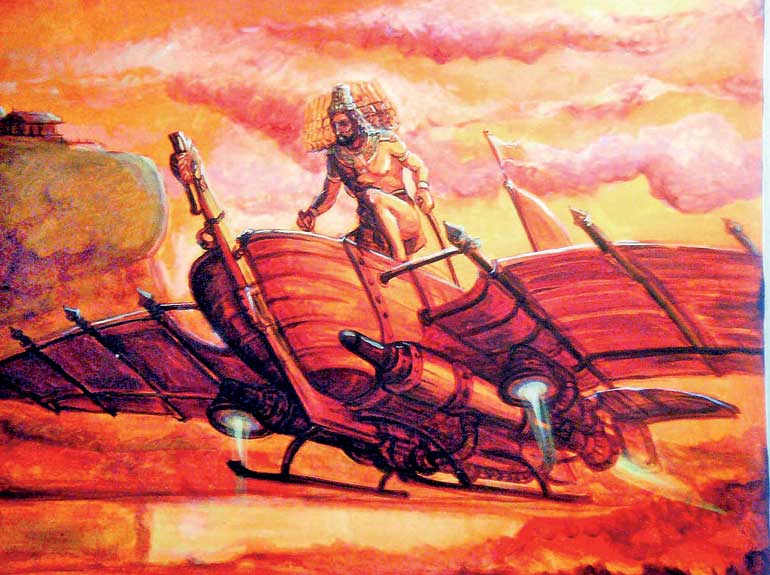
THE KING OF LANKA: Far be it from us to be alarmist! But there may be a move on to tap into the latently mythical psyche of the Lankan soul… And the aggro of road-trippers in a remote village of an ancient kingdom might be a hint and a harbinger of this anti-republican rot? (Pic shows Ravana, the legendary King of Lankapura, and his famed mechanical air-machine, the Dandumonara.)
Over this long weekend just past, yours truly and a trio of likeminded souls took to the hills – literally. Based in Kandy and keen to explore the Knuckles for their natural beauty, we discovered soon enough that only Man is vile in the Dumbara Valley. From Medamahanuwara to Meemure – an otherwise scenic trail of sylvan pine forests and gently undulating mountain terrain – there stretched the littered ruins of human consumption and carelessness. Maybe trashing the beautiful countryside was the least of their offences. My companions and I were challenged by the reality that while many Sri Lankans whom we encountered were innocuous innocent holiday-makers, a more insidious breed of road-tripper has begun doing the rounds in vale and plain.
One encounter rankles, and rang still-vague alarm bells. Rounding a hairpin bend on a narrow B-road, we were confronted by three van-loads full of happy campers. Two of their vehicles were parked considerately enough on the apron of the road abutting the semi-montane pine forest. But one van and its evidently inebriated occupants refused to budge so we could pass. All three vehicles were plastered liberally with Sinha-lé stickers. WTF, it’s our country? (Too!)
Which got me thinking. For a brief montane reverie between Hunnasgiriya and Kobonilla. What was it that had annoyed me more…the stickers; their roadhog manners? Or was it a combination of this churlishness and that chauvinism that irked my companions and I? There is such a thing as transports of delight where nature is beautiful in all her splendour, but only man is vile…
There was also an endless caravan of vans, jeeps, mini-buses, en route to Meemure right throughout my weekend getaway. From Corbet’s View to Corbet’s Gap (Attala Mottuwa), it was hard to get away from a strong and steady stream of vehicles flying Sinha-lé stickers. As if it was an ultranationalist convention from Udunuwara or some underbelly of chauvinistic jingoism. And if the slogan itself was not objectionable enough in our now intentionally pluralistic ethic, the selfishness of the road-hogs, sound polluters of the surrounding countryside, and careless litterers along the road was galling enough to introduce a small note of discord to our vacation from the grind of cosmopolitan Colombo.
So, what is it that draws the vehicular masses to Meemure – one of the remotest villages in Sri Lanka? There is only one badly scarred deeply rutted road – in places, no more than a dirt track – that leads to it, some 45km off the A26 main road to Mahiyangana. There is not even a postal service to the village, but only a makeshift ^Thaepael Handiya^ – a ‘postal junction’ from where villagers collect their correspondence with the outside world. There is no major hotel or minor resort; only a smattering of tea-kiosks and sundry cool-spots to quench the thirst of the bedraggled (or van-jolted) long-distance traveller.
But there is Ravana. Or rather, the ragged ends of folkloric tales about that mythical king of Lankapura – often and usually casually associated with the paradisal island of Lanka, the supposed ancient Ceylon (although some scholars differ, locating the prosperous kingdom in mainland India or some other legendary locale). Here is where the Rama-defying, Sita-desiring, warlord of the blessed isle launched his vaunted aircraft – the ancient Dandumonara, a mechanical airborne peacock – from the Lakkégala mountain range near Meemure.
It is a mythical tale with a mysterious tension about it. It is evidently a magical turning-point for the lonely romantic adventurer, ensconced safely in the anonymity of Sinha-lé, seduced by long-ago tales of Lanka’s aggression against Hindustan. It draws dozens (scores – even, thousands) of travellers and internal tourists to it < myriad moths to a mystical flame > like some latter-day local Macchu Picchu, Chichen Itza, or Stonehenge.
Could it be that the half-remembered, wholly misinterpreted, long-ago tales of Ravana and the rape of Sita have stirred a race memory in the nationalistically susceptible people of the political south of our land? There is rich irony, if so: Ravana was hardly a Sri Lankan king…simply a Rakshasa (demon) demigod who manipulated the Hindu gods Shiva and Brahma well enough to undermine the cult of Vishnu. An Indian subdeity, a committed Shaivite, the accidental ruler of ancient Lanka. Hardly an icon of Sinha-lé; notwithstanding his ostensible adoption by alien-leery, subcontinent-bashing, Sri Lankan nationalists!
Be that as it may, despite being a political opportunist (albeit an able warlord and something of a savant or sage…) – or, perhaps, because of it! – Ravana has been, time and again, clasped to the bosom of too many Sri Lankans’ fond nationalistic hopes and chauvinistic breast with hoops of steel. The trail of minions Meemure-wards bears ample testimony to something stirring in the soul of an older Lanka than our present republic and democracy.
So, how shall we interpret the ramifications of Ravana and his road-hogging would-be worshippers for Sri Lanka’s burgeoning – but possibly under threat – democratic republicanism?