

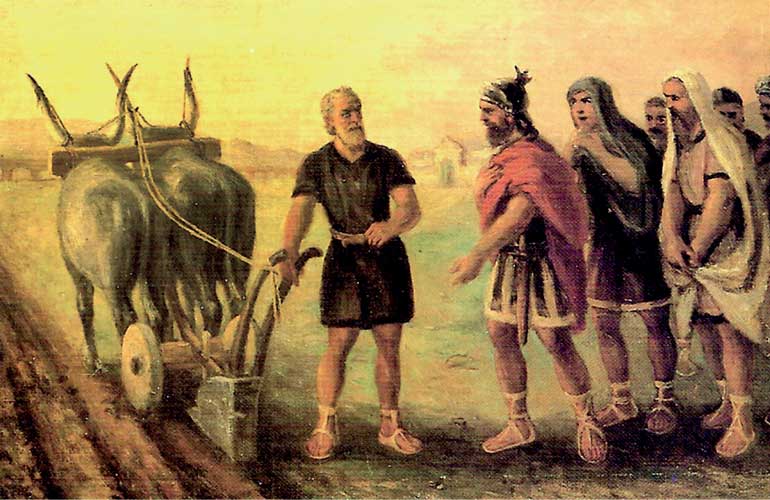
 Legendary model leader Roman republican Cincinnatus prioritised his agricultural acres over the affairs of state – until his country had need of his services. Duty done, this exemplary Consul then laid down his fasces – a symbol of real power – and retired to tending his garden in his sunset years
I want to ask if the way to extraordinary achievement in Cabinet or Council or Country is to recognise – and capitalise on that recognition – that there are diverse styles of leadership which characterise our politicians today?
Tell a politician: “The way to extraordinary achievement in Cabinet or Council or Country…” – and off goes that imagination: They will envision themselves in Parliament, in the full glare of the media spotlight, displaying vestiges of the lost glory of Lanka to television viewers! Or they might see glowing newspaper headlines pulsating with the more mundane patina of Provincial Council magnificence, the text glittering with examples of super-successful peripheral leaders illustrating the sub-text of their relative unimportance! Or ambitious Chief Executives – both incumbent Presidents or aspiring Premiers – could well imagine what posterity will say of their willingness to step down from the last great executive office to rule our land with an iron fist – or their ability to step up to the plate to rule it again with a velvet glove! But try prefixing the proposition at hand with “recognising others’ models of leadership …” and you will find the most stalwart of leaders shying away from sharing the credit or the glory with their fellow leaders – no matter how sterling they might be!
’Twas ever thus… ’Tis in the nature of the political animal. For leadership – for all your talk of servant-leadership or serving the people who elected you – is grounded in tangible realities such as:
- Power corrupting
- Passion for position overriding common decency
- Privileges of office stymieing good sense
- Persuasive men and women with convincing visions sidetracking national interests
- Personalities at interpersonal play and interplay
- Pleasures of leadership shouting down stern duty
- Pursuit of excellence overshadowed by private ambitions
- Progress of people and programmes from good to great weakened, threatened, by hidden agendas
How, then, could we begin to persuade the powers which be that there is something subversively desirable to the proposition that “recognising models of others’ leadership styles” is the primary factor in extraordinary political accomplishment? Well, read on!
Critics may carp and cavil, but there is an element of truth to it that leaders are neither born nor made, but only recognised early enough and encouraged to go from ‘good’ to ‘great’. Models of leadership do work, and these seem to work best where model leaders recognise a plurality and diversity of leadership styles. Today, maybe more than ever (ironically enough for a nation-state shaking off the shackles of a uniform but unfair tyranny) we need to ask our leaders if the existence of differing leadership paradigms is sufficiently recognised by them to leverage the talents and resources we have in the shallower ends of the political pool…
Do Presidents and Prime Ministers deliberate on whether their conscious acceptance and implementation of such paradigms makes a difference to their own political contributions? Is such a model inimical to greater accomplishments in Cabinet, Council, Committee, or Country?