

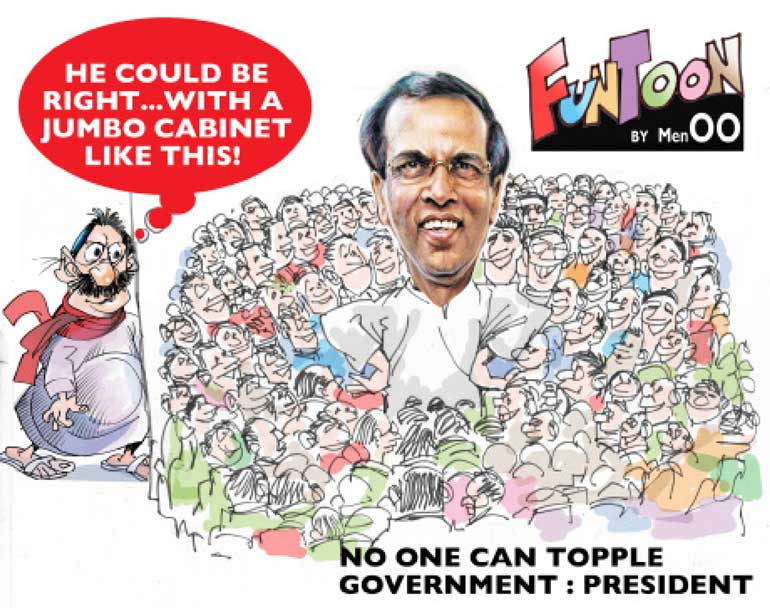
 Did you feel that democracy is the worst form of government? Except, of course, for all the others that have ever been! Could it be, though, that we have seen too little of it, of late, to appreciate it least when it works best…
We have experienced less of it than some supposedly mature occidental democracies, but more of it than many if not most of our oriental neighbours. Westminster-style parliamentary democracy in the early glow of our independence’s dawn had nice small cabinets; and only small change in terms of growth, development, progress.
Republican-style executive presidencies embraced more ambitious governmental and national developmental projects; but opened the door to the corridors of power for those who would usher in autocratic democracy or authoritarian republicanism. Realpolitik-driven coalition governments of the past two decades or so have seen gargantuan cabinets being built to bridge bipartisan divides; and explode the myth that a clean, strong, efficient, government has to be small and focussed for the most optimal impact. Ridiculously large and accommodating today, these are designed to accomplish the ambitions of a few – from the sublimely small and relatively exclusive cabinets of years gone by, which by default achieved the aspirations of many.
Good governance, when it raised its gorgeous head after much beating and battering under constitution-bending would-be despots, promised to end all of that. But it wasn’t long before the pragmatic dictates of politics based on a hamstringing electoral system that hangs too many parliaments made it turn aside for a moment for the worse, looking strangely attractive like some gargoyle’s head.
Bad enough the 19th Amendment under Good Governance’s vision of government by a single party/faction/coalition envisaged a small Cabinet of 25 and got us all excited; it also brought in the possibility of a large Cabinet of 50, 75, 100 – or more – Cabinet Ministers (at Parliament’s performers’ pleasure)… if and when the House was horribly divided and ‘national government’ was necessitated. That ugly reality was also envisaged by the shapers and moulders of 19A+/- and it looks as if democracy – which is neither good nor bad, but thinking makes it so – is set to pay the price of big, conjoined, united, symbiotic, government.
Worse than a distinct absence of separation of powers – as we saw with former regimes – is possibly the symbiosis of too many legislative forces, as under the present dispensation. Major Government = Minority Government + Minority Opposition Faction – Majority Opposition. Worst of all, we know this is a better form of democracy, even if we suspect it is less than the true substance of Good Governance.
Pros: the good
The best thing about so-called ‘national government’ is what Premadasa the Elder would have labelled ‘Consultation, Compromise, and Consensus’. Consultation has all the positive ramifications of a nation talking to itself via its elected representatives. There is a healthy benefit in compromising, in that no lone rangers or solitary visionaries get to set and drive the agenda, especially against the grain of the national interest. Should a plan or project or policy or programme to progress well and be implemented effectively, the stakeholdership that comes from consensus would cement Cabinet prerogatives and Parliamentary initiatives together. And yet…
Cons: the bad
The very thing about the “three C’s” formula is that is has a less favourable flip side. Consultation now means that those whom the polity rejected are not only back to occupy the seats they were deemed unfit for in Parliament but are, perforce and not perchance, holding important Cabinet portfolios into the bargain. Compromise – as we saw in dilution of 19A’s original and potent incarnation – often and usually means that what survives backroom deals and horse-trading is less than savoury (lifting of travel bans?) and often unfit for a full-bodied republican regimen. Consensus can sometimes necessitate that there is honour among thieves – and rogues and robber barons of all ilks – and that what was *pro bono publico* under a benevolent and dominant tyranny is now *pro bono politico* under an ersatz democracy.
Neutrals: the ugly
The not so nice thing about a Government by the Government for the Government is that while propagandists can convince Parliament and spinmeisters can persuade Civil Society that it is the people’s interests that are being served, in reality it is a Pantagruelian Parliament’s interests that are seen to be serviced. For nearly nine months soon it would have been the case that members on both sides of the House have sat on the same side of the table, thinking, in typical Parliamentary style: “Spoon hand having while, serve self” (it works better in Sinhala translation).
This is not to say that no good – union in vision, unity of purpose, expedition of works, economies of scale, effectiveness in implementation – can come out of separate factions coming together in the common good. With that said, it might be argued that what has transpired is that the uncommonly evil – allegedly corrupt and aggressively cynical ‘congressmen’ with an eye on the main chance – have been turbo-injected back into the political mainstream where they can hold a big and growing government to ransom. Crooked politicos holding the nation hostage was a thing of the past… Or so we thought – Now it has been introduced and sanctified as the ‘new political culture’.