

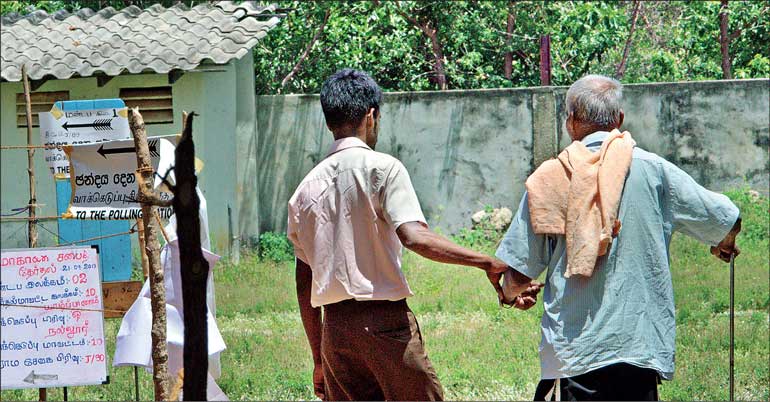
The citizenry vote for politicians in the vain hope that ‘this time there will be change for the better’ – Pic by Shehan Gunasekara
Despite the critical engagement of scholars and other writers in the mainstream media attempting to introduce leadership models with countervailing themes such as plurality, inclusiveness, sensitivity, empathy, acute self-knowledge and other ‘softer’ attributes, the essence of political leadership in Sri Lanka in the intervening decade and a half after the end of the so-called ‘ethnic war’ has seen a hardening of positions
 As Sri Lanka gears up for elections later this year, people of voting age would do well to gird their loins against being gulled again into casting their ballots unwisely for those whom we call our ‘leaders’.
In the past we’ve voted repeatedly for crooks, charlatans, the incompetent, the corrupt, and the utterly unrepentant of their litany of crimes.
To add insult to injury, we chronically elect as our representatives those who couldn’t organise a proper punch-up in parliament where chilli-filled paper-bag- and chair-throwing is two a penny but still have the gumption to stand for public office as if their House is in the order they say they want the Nation to be in.
As political analysts and commentators have observed, the citizenry vote for politicians in the vain hope that ‘this time there will be change for the better’; and the electorate is disappointed time and again – although ‘next time round’, too, the voting population opts to invest their faith in the electoral system all over again.
As Prof. Jayadeva Uyangoda and Dr. Pradeep Peiris observe: “There is also a growing dissatisfaction with, and a lowering of trust in, the functioning of political parties. This has led to a paradoxical situation. People feel that the political parties are essential to the functioning of democracy but do not seem to trust them for making democracy work…” (State of Democracy in Sri Lanka: a Preliminary Report, PCD Journal 2009, pp. 57-74).
It is a perennial or cyclical problem that has many root causes.
For one, the ethos of party-political leadership whereby political leaders prefer to nominate party candidates who will sweep the polls even if their ethics are questionable.
For another, the entrenchment of the patron-client system whereby government and citizenry are both complicit in the two part tango ‘for every giver/taker, there is a taker/giver’ model of transactional politics.
As Uyangoda and Peiris have it: “Political parties have become election and patronage machines.”
Then again, the calibre of independents seeking public office leaves much to be desired in terms of moral, ethical and personal probity. It is self-service not service they seek.
Last not least, a rotten political culture where those whom we elect to lead us seek to serve themselves and their political masters, and vested interests among the elites who paved their path to power, and not the people who voted them in or the country’s more pressing causes.
We look at the latter of these today, from a conceptual point of view, and attempt to develop a framework for aspiring Sri Lankan politicians to take cognisance of.
Or party leaders – and here we can but hope against hope, despite empirical evidence and the experience of decades indicating otherwise – to heed the need for better leadership.
Or both politicos and their sponsors to note and act upon these in the larger national interest over and above narrow partisan gains and petty agendas.
Thinking about leadership
Leadership is a topic that has been much discussed but little agreed upon in terms of definitions, essence vs. attributes, and praxis.
There are “many diverse ways of thinking about leadership”, according to Harvard University Professor William E. Allen in ‘Leadership Theory: A Different Conceptual Approach’ in the Journal of Leadership Education (2018).
Although scholars are almost universally agreed that “creating a logical and consistent picture of the state of leadership theory is a difficult task” per leadership thinkers such as Hernandez, Eberly, Avolio and Johnson (2011), it is increasingly evident in a world suffering from a ‘leadership deficit’ that defining, developing and applying meaningful, relevant and sustainable models and theories of leadership is the need of the hour worldwide.
‘Leadership deficit’ is a term coined by Thomas J. Tierney in relation to nonprofit organizations; but now, it is increasingly applied to civics, politics and governance (cf. Tierney, Thomas J, ‘The Leadership Deficit’, 2006, as quoted in the Stanford Social Innovation Review 2006).
A slew of scholarly papers by the likes of academicians Harter (2012), Martin & Allen (2016), Paxton & Van Stralen (2016) and Perkins (2019) have already identified this need; and Allen argues for “a new point of view [that] encourages discussion with the hope for a more efficacious understanding of leadership theory in any part of the world”.
In our part of the world, in this day and age, as a nation and its people prepare for presidential and general elections in the year ahead, it is timely and prudent to apply ourselves to developing a solid national political leadership framework.
Local models and native wit
Controversy surrounds the emergence of a particularly Sri Lankan model of political leadership in the years after the cessation of hostilities between the Government and separatist terrorist forces in May, 2009.
Academics and journalistic commentators have identified the attributes of this style of governmental, national and political leadership as being a variety of elements native to the Sri Lankan ethos, as follows:
- “authoritarian” (Benny Kuruvilla, ‘Sri Lanka: a cautionary tale of authoritarian neoliberalism’, Focus on the Global South, 2022)
- “increasingly militarized” (Ambika Satkunanathan, ‘Sri Lanka continues to militarise the state, despite the Rajapaksas’ fall’, Himal South Asian, 31 July 2023)
- “based on a patron-client model” (Oscar Amarasinghe,, ‘Political Clientilism and Underdevelopment’, University of Ruhuna, 1994)
- “a mixture of paternalism and alliance developed through political dynasty, kinship, ethnicity [and] caste” (Ramesh Ramasamy, ‘Governance and Administration in Sri Lanka’, Emerald Insight Vol. 23, Issue 2, 2020).
Despite the critical engagement of scholars and other writers in the mainstream media attempting to introduce leadership models with countervailing themes such as plurality, inclusiveness, sensitivity, empathy, acute self-knowledge and other ‘softer’ attributes, the essence of political leadership in Sri Lanka in the intervening decade and a half after the end of the so-called ‘ethnic war’ has seen a hardening of positions.
This is evident in stances among governmental ranks and corridors of power, including among the establishment and entrenched political culture – embracing political leaders of all parties, policy imperatives and personality types.