

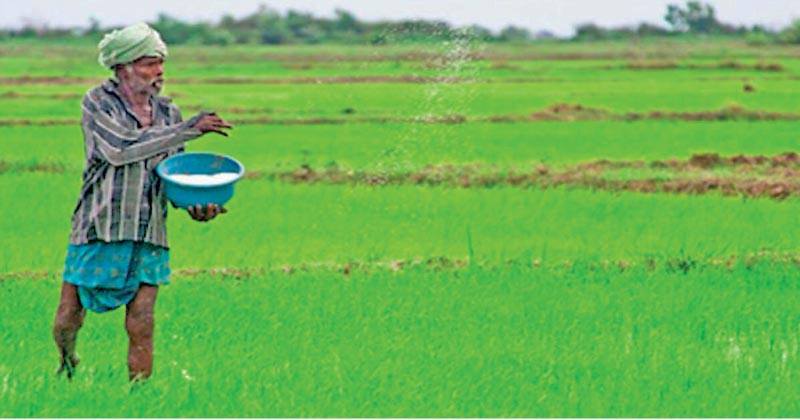
The GOSL introduced its fertiliser policy of 2021 to stave off severe forex outflows but did not anticipate the issues angry farmers of all types island-wide would face
 The primary reasons adduced by most expert observers are that the overnight fertiliser policy was abrupt, short-sighted and implemented with inadequate consultation of primary stakeholders. Compelled to go organic overnight, most cultivators of a cross section of crops did not possess the requisite tools, skills, resources, implements and knowledge to successfully deploy organic farming practices. Had the GOSL followed a more studied sustainable approach, the policy may have succeeded in the short to medium terms.
In May 2021, the Government of Sri Lanka (GOSL) introduced a swift and sudden ban on the importation of all chemical fertilisers, pesticides and herbicides. The administration of then President Gotabaya Rajapaksa had hoped that this policy of compelling the nation’s farmers to ‘go organic’ almost overnight – no more subsidised fertiliser – would save State coffers up to US$ 400 million on imports annually.
With the implementation of such an abrupt ban, farmers island-wide began to face unprecedented challenges in maintaining their agricultural output. Home-grown organic fertiliser – often, based on cow dung, chicken manure, sundry dried fruits and dead flowers, banana tree leaves and trunks, weeds, and ginisiriya – was not only labour-intensive but took over a fortnight to make (Bertie Harrison-Broninski, ‘Why was organic policy blamed for Sri Lanka’s financial crisis?’, Land & Climate Review, 21 Jun 2024). And to add insult to injury, organic fertiliser available from government depots were substandard as well as being in short supply (ibid).
After months of severe hardships for paddy and other farmers, widespread protests across the agricultural belt and dire threats to Sri Lanka’s food security, including reductions in crop yields (e.g. 40%-60% drop in rice and potato outputs) and having to buy more of its food stocks from overseas, the fertiliser ban was revoked in November 2021.
In the intervening six months, not only did the welfare of farmers face extreme stress but the tension spilled over into national well-being as well, and subjected the GOSL and the incumbent administration’s policy-making ability to widespread questioning. This was despite a 2018 survey finding that 74 per cent of farmers feeling that they had ‘good’ or ‘very good’ understanding of organic agriculture – two-thirds of which had learned about it from state training programmes (Harrison-Broninski, 2024).
Interestingly, in 2022, four years after the study above, and only after a few months since the ban on agrochemicals ended in November 2021, new research found that “most Sri Lankan farmers now advocated using only chemical fertiliser … 43% of the respondents preferred a mixture of organic and chemical, and only 1% wanted to farm only organically” (Harrison-Broninski, 2024).
The fertiliser policy/organic farming fiasco brought Gotabaya Rajapaksa’s supposedly ‘technocratic’ regime into disrepute, and was one of the root causes of the sociopolitical turmoil that ensued in 2021/2022, and made Sri Lanka’s sovereign debt default and bankruptcy that much harder to bear.
Rationale for organic agriculture policy
There were many reasons for the GOSL to introduce such a swift and sudden ban. The proposed fertiliser policy of May 2021 was not an isolated one. President Gotabaya Rajapaksa’s administration had been under pressure on several other fronts at the same time. According to environmental organisation Greenpeace, “The immediate cause of Sri Lanka’s crisis [at the time] was straightforward: basically, the country ran out of foreign reserves.” (Young, N. ‘Sri Lanka’s fertiliser ban’, 2020).
Following a rapid and alarming dwindling of foreign-exchange (forex) reserves, the GOSL fertiliser policy was aimed at reducing a forex drain through eliminating the need to fork out this valuable asset to import chemical fertilisers et al.
While Rajapaksa and his ‘Viyath Maga’ advisors claimed that the policy was introduced because the conversion to an organic regime was ostensibly in Sri Lanka’s best interests from ecological and human health perspectives, many economic experts were of the opinion that blocking debilitating the forex drain was the principal reason for the policy.
Championing a suspect cause
Despite the GOSL at the time and President Gotabaya Rajapaksa being at the helm of the overnight fertiliser ban, the possibility of Sri Lanka transitioning to an organic farming regimen in a more sustainable manner had been on the cards for a longer time than the administration that introduced the disastrous policy.
The potential for organic agriculture taking root in the island nation can be dated in recent times to a policy of former President Maithripala Sirisena; who, in 2015, announced his plans for a ‘toxin-free nation’ that was to be effected through “a nation-wide transition to organic agriculture and ban on agrochemical imports aiming to guarantee citizens the right to ‘nox-toxic food’” (Figeczky, G. ‘Why We Cannot Blame the Sri Lankan Crisis on Organic Farming’, Organic Without Boundaries web article, 2022).