

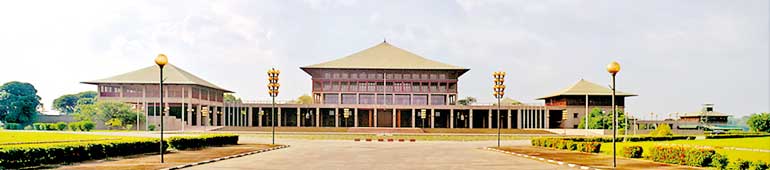
 A legendary Aussie PM once said in a speech to the Australian Labour Party: “I do not mind the liberals, still less do I mind the country party, calling me a b*st*rd. In some circumstances, I am only doing my job if they do! But I hope you will not publicly call me a b*st*rd – as some b*st*rds in the Caucus have…” – O tempora! O mores! We seem to have picked up this dastardly parliamentary habit – and the public have caught it in spades from their elected representatives
I used to think >We Sri Lankans were good at many things. Warm hospitality. Winning at cricket. Warping and woofing lingerie. Working less than anyone else. Well, there’s a new talent to add to the list. Now, it’s the consummate skill or ease with which we call each other names. It is our newly-liberated nation’s least lovely character of courtesy.
As with any ethos worth percolating, the grounds distil from the top. A firebrand Member of Parliament recently called a Very Senior Politician (VSP) a ‘fornicator’ in the vernacular – in the House. The vexed VSP, usually the very flower of chivalry, retorted that the MP was nothing more than a mere ‘turnip’ – or the local equivalent thereof. That it may have been a reference to the MP as a whole or a part thereof was not a moot point. It behoves parliamentary gents not to speak in the House as if they were speaking of unparliamentary hullabaloos in the gents.
Say my name!
But this trend prevails. Both in and out of the House. Of late, a VSP – the same one who suffered ignominy in the imbroglio above – has taken to calling scribes, who will not bow or kowtow to his government’s line, “frogs”. No doubt many scribes, who once had the appellation “wild asses” bestowed on them by one of our VSP’s VIP cabinet colleagues, spend their lives as insularly as do frogs in a well. It is no excuse to traduce detractors of the incumbent administration by reducing them to amphibian ranks, however. A leader – and a respected thought-leader, at that – must model the example he desires to communicate.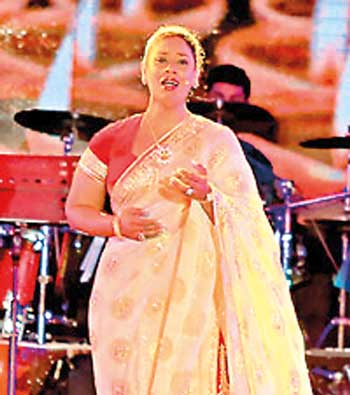
That same thought-leader – and generally a gentlemanly leader, to boot – was more recently on the side of the angels. This was when he expressed umbrage, which was more or less universally felt, at the calling of names of a soprano who sang a much loved religious song in operatic style – and had a feline epithet attached to her repertoire. The freedom of the wild ass is one thing. It’s altogether a different kettle of fish when the offending media-donkey drops a brick, which is no doubt best used to pick up to despatch the offender himself. If the offender had not been dismissed from office in due course, perhaps even more vegetative MPs may have taken up cudgels on behalf of the offended party – and if it meant siding with those whom they thought of as ‘fornicators’, no harm done…
What’s in a name-call?
What is worth investigating, however, is the attraction that name-calling holds for us. Maybe one or more of the possibilities below holds some promise in understanding it?
# Power over the ones whom you call names
# Safety valve to release pent up societal tensions or valences
# Calumny or heaping contumely on others’ heads to sanctify your own tribe
The first of these, at first blush, seems to strike a chord with the human experience throughout history – at various times, in various spheres of activity.
Ancient religions, for instance, are rife with lore about the power of naming. The powerful Egyptian sun-god Ra, or Amon-Re, was usurped from his heavenly throne when the goddess Isis discovered his true name by dint of a cunning trick – who then installed her son Horus in Ra’s place.
Biblical narratives also provide fodder for thought in this sphere. Runaway usurper Jacob tries returning to his native land… but finds that he cannot enter into the promise of his forefathers before he has wrestled with an anonymous divine presence. This mysterious messenger of God never reveals its own name… rather, he or she extracts Jacob’s real name (‘cheat’ or ‘struggling usurper’); before dislocating its earthly interlocutor’s hip – and departing after bestowing a blessing: a new name (Israel: ‘prince among people who contended with God and Man’).
Cultures other than the Ancient Near Eastern (or Ancient West Asian) betray humans’ fascination with the power of true names. Germanic folklore is full of such stories – generally in the form of Grimm’s or grimmer fairytales. Remember the legend of Rumpelstiltskin – the ogre who tried to steal a girl’s child, but was bested because the maiden learned the monster’s real name in the nick of time?
What price background checks?
The second and third possibilities are arguably no less well-attested in the social sciences. Name-calling among children – especially teens – is a recognised safety valve to release pent up societal tensions or valences. No extra-classroom atmosphere worth its salt would dream of imposing censorship on the names that schoolboys, for example, would call each other on the cricket pitch or rugby field. A problem that persists beyond such juvenile delinquency is that should-be less-scruffy worthies insist on acting like schoolboys in more august assemblies than one’s local alma mater – such as one’s national parliament.
What lies beneath
The problem with <Us Sri Lankans is that name-calling is just the tip of the ice-berg. It soon enough degenerates into dropping-bricks. Or worse, stone-throwing. Left to its own devices and evil intentions, it can escalate into such a fury of vituperation that small towns on our tropical island’s southwestern coast were once – not too long ago – under threat of being set ablaze.
Until recently, the principal actor in the name-calling and threatened brick-throwing was at large. Still, the ugly names that Sinhalese and Muslims called each other across the language among other manufactured and cynically sustained divides reverberate underground. Dangerously, the ideologies based on the malicious naming of parts, and people, and places, vibrate volcanically under the smooth surface of polite society.